Hear No Evil: A UK Privacy Diet for Audio-Enabled CCTV in 2026
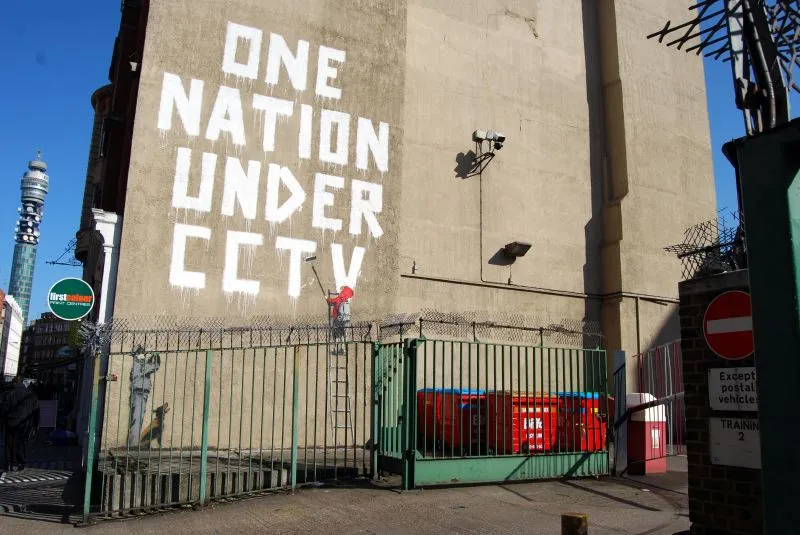
Photo: Banksy, CC BY-SA 2.0, via Wikimedia Commons
CCTV is usually discussed as a visual technology: lenses, angles, fields of view and the familiar silhouette of a camera on a bracket. In 2026, however, a growing number of UK systems are also listening. Microphones now appear in shop cameras, council-run public space equipment, doorbells, workplace systems and consumer-grade cameras sold for home use. Some are explicit. Others are quietly enabled by default and discoverable only through an app, an admin panel or a small grille on the casing.
For anyone responsible for a camera — or living near one — audio raises a different set of questions from video. A picture of a street is one thing; a recording of a conversation is another. Audio can capture names, health details, arguments, religious references and personal relationships. It can turn a routine surveillance system into a richer and more intrusive record of daily life. The practical task is not to assume that audio is banned, but to ask whether it is necessary, lawful and proportionate — and, where it is not, to turn the volume down.
The camera is only half the story
Many UK CCTV installations are sold as video systems but shipped with audio capability. The microphone may be built in, supplied as an add-on, or available through a paired app. In commercial systems, audio is often marketed as an analytics feature: aggressive-language detection, loitering alerts, till monitoring or incident review. In public spaces, the stated purpose may be public safety or anti-social behaviour detection. In homes, it may be convenience, parcel monitoring or simply a default setting nobody changed.
The privacy risk is cumulative. Video identifies that someone was present. Audio may reveal what they said, who they were with and how they sounded. That can be useful in a genuine incident, but it also creates a searchable record of everyday conversation. Under data protection law, that record is personal data. It must be handled with the same care as any other personal data, and it must be justified.
What the law permits — and what it asks first
There is no blanket UK prohibition on audio-enabled CCTV. The UK GDPR and the Data Protection Act 2018 allow audio capture where an organisation has a lawful basis, processes fairly and transparently, and keeps the processing necessary and proportionate. For a business, the basis may be legitimate interests. For a council or public authority, it may be public task. Consent is usually a poor fit for public space surveillance because people cannot realistically refuse while going about their day.
Several obligations matter particularly for audio. First, transparency: people should be told that audio is being captured, not just that CCTV is in operation. A sign that says CCTV may not be enough if the system also records sound. Second, minimisation: if video alone meets the purpose, audio should normally be disabled or not installed. Third, retention: audio should be kept only as long as necessary, and often a shorter period than video is appropriate. Fourth, security: audio recordings should be access-controlled, logged and protected against unauthorised listening.
A data protection impact assessment is likely to be appropriate where audio surveillance is widespread, systematic or used in public spaces. Audio can also capture special category data — for example, references to health, religion or sexual orientation — which requires extra care. The question is not whether a camera can record sound, but whether the organisation has thought through why it is doing so and what safeguards apply.
PECR, networks and the limits of a familiar acronym
PECR — the Privacy and Electronic Communications Regulations — is often mentioned alongside CCTV, but it is not a general audio surveillance statute. It deals principally with electronic communications, cookies and marketing. Its relevance to CCTV is narrower. It can matter where audio is transmitted over networks, where communications data is involved, or where a service processes information about users. It should not be treated as a substitute for UK GDPR analysis.
The practical point is that an audio-enabled camera may engage more than one legal regime. A networked device that streams sound to a cloud service raises questions about security, access and international transfers. A system that records calls or uses voice analytics may need separate notices and controls. Organisations should avoid assuming that a CCTV sign, a privacy notice or a software setting covers every audio use.
How to tell whether a camera is listening
Audio capability is not always advertised. Look for small microphone holes or grilles on the camera body, often beneath the lens or on the underside of the housing. Check the model number against the manufacturer's specification. Examine the admin interface or app for audio settings, microphone icons, recording toggles or voice analytics. Ask the operator directly whether audio is enabled, where it is stored and who can listen.
In shops, audio may be linked to till systems or incident detection. In public spaces, it may be part of a wider analytics platform. At home, doorbells and indoor cameras frequently include two-way audio and may record sound even when the user thinks they are only watching. If a camera has a physical mute switch or a removable microphone, that is often the simplest control. If it does not, software settings should be checked and documented.
A practical audio-privacy checklist
Homes
Disable audio on doorbells and outdoor cameras unless there is a clear need. Keep cameras pointed away from neighbours' gardens, windows and shared paths. Check whether the app records sound by default and reduce retention. If audio is needed for parcel handling or access control, explain it to household members and visitors where appropriate. Remember that the domestic exemption is not unlimited: audio that captures neighbours or public spaces can fall outside ordinary household processing.
Workplaces
Audio should not be used in toilets, changing rooms, rest areas or other private spaces. Employers should be able to explain why sound is necessary, how long it is kept and who can access it. If voice analytics or call recording is used, separate notices and controls are needed. Staff should know whether they are being recorded and how to raise concerns. A camera that watches a till need not necessarily listen to a conversation.
High streets and public spaces
Operators should display clear signage that mentions audio, not just video. Councils and private landlords should be able to point to a documented assessment, a retention policy and an access policy. Audio analytics such as aggression detection should be tested for accuracy and bias, and should not become a default extension of every camera. In residential-adjacent spaces, audio should be off unless a specific, evidenced need exists.
Asking, objecting and escalating
Individuals can ask an organisation whether their audio has been captured by making a subject access request. They can also ask for information about the purpose, retention and sharing of audio. Where processing relies on legitimate interests or public task, there may be a right to object. That right is not absolute, but it must be considered. In some circumstances, restriction or erasure may be appropriate.
Start with the operator's privacy notice and a written request. Keep the request specific: ask whether audio is enabled, what it is used for, how long it is retained and who has access. If the response is unsatisfactory, a complaint to the Information Commissioner's Office is the next step. For public space systems, local councillors and relevant scrutiny committees can also be useful routes.
Designing for quiet
The most effective audio privacy control is not a clever setting; it is a decision not to record sound in the first place. Buyers should ask vendors whether audio is enabled by default, whether it can be physically disabled, where recordings are processed and whether analytics can be turned off. Operators should document the purpose, review retention and train staff not to use audio for idle monitoring.
In 2026, the UK's surveillance estate is more capable than ever, but capability is not the same as justification. A camera that listens should be the exception, not the default. The quieter system is often the more defensible one.