Back Seat Driver: Taking Control of What Your Dashcam Keeps and Who Sees It
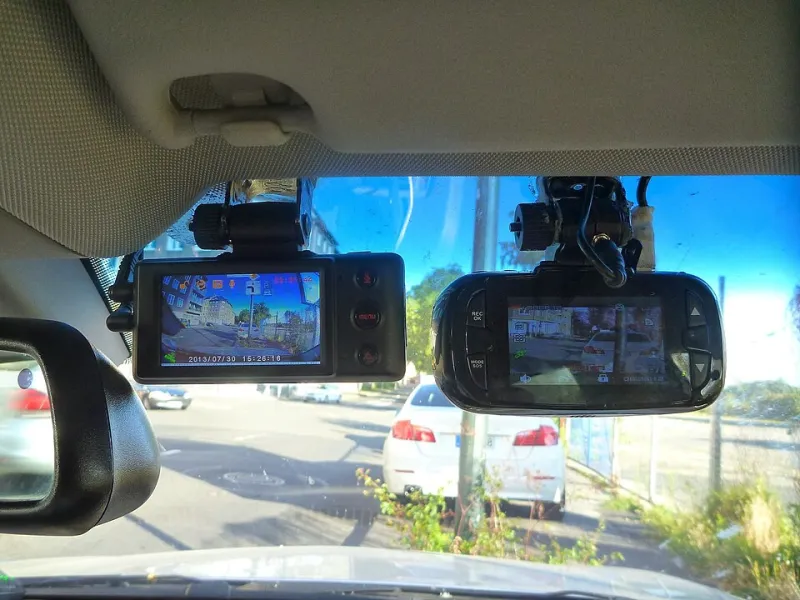
Photo: Fernost, Public domain, via Wikimedia Commons
Few pieces of consumer technology have spread through British motoring as quietly as the dashcam. It sits behind the mirror, records in a loop, and is forgotten about until someone needs a clip. That convenience carries a cost. A modern unit is a recording device, a GPS logger and, increasingly, a connected node that uploads to a manufacturer's cloud. The result is a running archive of personal data about you, your passengers and everyone who passes within a few metres of your bumper.
The witness on the windscreen
Even a basic model records more than most owners realise. A typical setup captures forward-facing video, continuous GPS traces, speed derived from satellite data, and timestamped number plates on approaching and following vehicles. Higher-end devices add a rear camera, infrared for night parking mode, motion-triggered buffering and an interior lens.
Audio is the most commonly overlooked feature. Many units ship with the microphone enabled by default, which means private conversations, phone calls and the details of passengers who never agreed to be recorded end up on the memory card. Cloud-connected models go further still, pushing clips to a vendor platform over a built-in SIM, sometimes together with location history held on the manufacturer's servers.
Under UK data protection law, footage that identifies a person is personal data. The car does not need to be a business asset for that to be true.
Who can ask, and who can compel
The single most common question from drivers is whether they must hand footage over. The answer depends entirely on who is asking.
The police
Officers frequently make informal requests at the roadside or by follow-up visit, and voluntary cooperation is often the fastest route for everyone involved. Where footage is likely to be relevant evidence of an offence, police also have powers of seizure under the Police and Criminal Evidence Act 1984, which can extend to a memory card or a device holding the recording. In practice, offering a copy rather than surrendering the hardware is normally a reasonable first position. Ask for the officer's name, collar number, station and a reference, note what offence is being investigated, and record what you provided and when.
Insurers
Insurers may request footage as part of claims handling. This is usually a contractual matter rather than a legal power: the obligation flows from the terms of your policy. Refusing is not automatically unlawful, but it may affect how a claim is handled or assessed. If the footage is potentially unhelpful, seek advice before sending it.
Other drivers and members of the public
A motorist involved in an incident has no automatic right to your recording. They can make a subject access request if they believe their data is held, and in litigation a court can order disclosure. Requests made through social media, community groups or a third party are not legally binding, whatever their tone.
Employers and fleet operators
If the vehicle is a company car or part of a fleet, the employer is likely to be the data controller for footage recorded in the course of work. That brings a full set of obligations: a lawful basis, a privacy notice for staff, a documented assessment of the monitoring, retention rules and restrictions on using recordings for performance management unless that purpose was clearly set out in advance.
The rules that travel with you
UK GDPR and the Data Protection Act 2018 follow the camera into the car. The so-called household exemption, which covers purely personal and domestic activity, is narrower than many owners assume. Regulators and courts have consistently held that filming public roads and identifying strangers goes beyond domestic life, because the recording affects people outside the household.
In practice that means four disciplines:
- A lawful basis. Most private drivers rely on legitimate interests, which requires a genuine reason and a balancing of your needs against the privacy of those filmed.
- Minimisation. Record what you need, not what you happen to capture. A microphone you never use is data you cannot justify.
- Storage limitation. Keep clips for as long as there is a reason, then delete them. Indefinite hoarding of years of journeys is difficult to defend.
- Security. Encrypt or PIN-protect the card, keep the app account secured with two-factor authentication, and know where cloud footage physically sits.
Two further points catch people out. A subject access request must generally be answered within one month and free of charge, so an owner who receives one should take it seriously. And publishing a clip online, whether to name and shame a driver or to seek witnesses, converts a private record into a public disclosure with its own risks. The Information Commissioner's Office has been consistent on this: blur faces and plates, keep commentary factual, and do not turn a collision into content.
Configuring the car
A short session with the settings menu resolves most of the risk:
- Switch the microphone off unless there is a specific reason to record sound.
- Set the loop length to a short interval and check that parking-mode sensitivity is not triggering on every passing cat.
- Decide on cloud sync deliberately. Automatic upload is a convenience and a liability; if enabled, review retention settings on the vendor's platform.
- Encrypt or PIN the memory card where the device supports it, and carry no more than one spare.
- Review before sharing. Most units and companion apps include a trimming tool; use it, and redact bystanders where possible.
- Log every disclosure in a note on your phone: date, recipient, what was supplied, and why.
- Wipe the card before selling or part-exchanging the car, and deregister the device from your account.
When someone asks for the clip
Stay calm and stay procedural. Confirm identity and authority, ask what the footage is for, offer a copy of the relevant segment rather than the whole card, and take a receipt if hardware changes hands. If a request feels excessive, ask for it in writing. Nothing about cooperating with a genuine investigation requires you to hand over weeks of unrelated journeys.
The bigger picture
The value of dashcam footage does not lie in a single clip. It lies in aggregation: insurers building incident models, police forces correlating number plates, manufacturers holding location histories across millions of vehicles. Owners who treat the device as an ordinary camera, rather than a sensor with a paper trail, remain in control of what it keeps, for how long, and who sees it. That control is worth a few minutes in the settings menu.